
Translational Chemical Biology T32 Training Grant
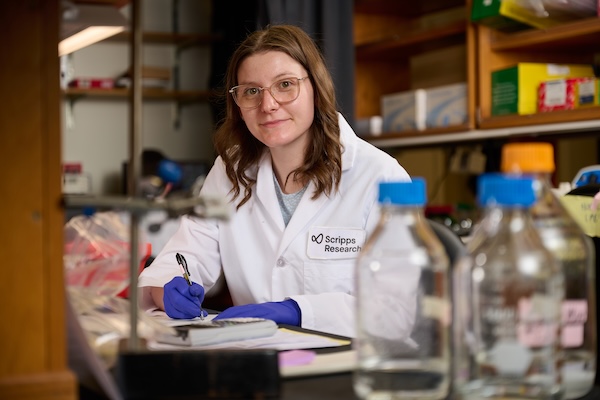
Scripps Research has been awarded a T32 Pre-doctoral Training Program grant (T32GM159580) by the National Institutes of Health, focused on Translational Chemical Biology. This training program, distinct from other existing training programs at Scripps Research, is designed to coordinate Scripps Research's existing associated infrastructures in basic science and drug discovery efforts with chemical biology training.
Students trained in this program will enter the competitive biomedical workforce as leaders with advanced knowledge in the process of advancing basic biomedical ideas toward drug discovery and development.
LATEST NEWS
Sept. 2025 - The 2025 cohort has been selected! The inaugural class of ChBioT32 trainees will include:
- Gabrielle Cruz
- Sebastian Fernandez
- Thomas Freirich
- Jordan Janowski
- Alexander Lin
- Pierre Loch-Temzelides
- Cecilia Panfil
- Kristal Stevens
- Jason Tse
- Jessica Vance
Scripps Research is an established leader in chemical biology, and we are rapidly becoming a leader in translational research. Despite our small footprint, we have contributed significantly to the development of several drugs on the market. Our leading positions in these areas have occurred because of our strategic focus on biomedical research, the strength of our faculty who are leaders in their respective fields, especially in chemical biology, and our seamless environment for collaboration. In parallel to our scientific discoveries, we have also established a world-class pre-doctoral graduate training program. Armed with successes in both areas, this application is centered on the opportunity to systematically leverage our strengths and train a new cadre of translationally-focused cohort of chemical biology pre-doctoral graduate students. This training program, distinct from other existing training programs at Scripps Research, is designed to coordinate our existing associated infrastructures in basic science and drug discovery efforts with chemical biology pre-doctoral training. The trained students will enter the competitive biomedical workforce as leaders with advanced knowledge in the process of advancing basic biomedical ideas toward drug discovery and development efforts.
- Coordinate existing training activities into a translational chemical biology-focused program
- Bring predoctoral students into the fold of drug discovery research at Scripps Research
- Further promote interdisciplinary training at Scripps Research
- Encourage greater participation of faculty in synthetic organic chemistry, as well as in drug discovery, in predoctoral training efforts
- Encourage participation from local biotechnology and industrial partners in predoctoral training efforts
- Provide said industries with the needed scientific talent trained at the interface of basic chemical biology and translational drug discovery
- Transform collaboration at Scripps Research into a skill that can be taught and learned
Develop a cohort of individuals with training in chemical biology and drug discovery, so that they can:
- Design, synthesize, manipulate, and characterize molecules (including macromolecules),
- Foresee the biological potential of the compounds they work with,
- Apply chemical principles for the design of new compounds to answer biological questions,
- Identify biological problems that can be addressed with fundamental chemistry or chemical biology solutions,
- Develop innovative solutions to identify new biological targets,
- Develop new approaches to accelerate the identification of candidate drugs or identify the molecular mechanisms of molecules,
- Evaluate the real translational potential of a compound or proposed drug candidate.
Upon joining the T32 program (at the onset of Year 2 of their graduate school timeline), each trainee will have already completed laboratory rotations and their curricular training. Also, they would have already been acquainted with methods and research directions of their chosen laboratory. Concurrently, upon selection and at the onset of Y2 of their graduate program, trainees will identify a group of three graduate faculty members to serve as graduate committee members. These committee members should provide either key technical or domain knowledge relevant to the trainee’s scientific goals, or support for the trainee’s career development. Each trainee will receive guidance from the Training Program Directors and the Office of Graduate Studies regarding this selection
Coursework
Chemical biology didactic education is rooted from the basic principles of the central dogma, progressing from genes to proteins, post-translational modifications, and higher-order cellular structures and progresses towards core application areas, such as imaging, chemical genetics, activity-based protein profiling, and natural product discovery and biosynthesis. T32 trainees are required to complete Chemical Biology coursework by Year 2.
Translational Chemical Biology Workshops
Quarterly bootcamps attended on a voluntary basis that are led by practicing academic and drug discovery scientists. Participants are encouraged to bring specific questions to discuss bottlenecks they are facing in their own projects.
Seminars
T32 trainees are required to attend at least 80% of Departmental lectures. In addition, T32 trainees must participate in a monthly chemical biology student-led seminar (content ranges from assigned material to research-in-progress talks or a a historical review of Scripps-related assets). Attendance at the annual Richard Lerner Frontiers in Chemistry Symposium is required.
Requirements
Work in a Participating Faculty lab. Student-Mentor teams should meet annually to discuss Individual Development Plans. Mentor must be committed towards training, mentoring, and providing a supportive research environment. Trainees must participate in designed workshops and present their work in the Graduate Student Symposium or in a satellite symposium (max once annually).
Additional Benefits
$3,000 is allowed annually per eligible trainee to support childcare costs. These funds are restricted and cannot be used for any other purpose. Each trainee is provided a $300 annual allowance to participate in local, national, or international scientific meetings.
Career Development
Participation in Career Development workshops offered by the Office of Career and Professional Development is required. Some options include Training in Relationship/Collaboration Skills ("The Science of Team Science"), a Chemical Biology Internship Program (6-8 week internship with local biotech and pharmaceutical partners either in Year 2 or 3), our Chemical Biology Alumni Mentorship Program, Effective Career Planning for PhDs course, or Industry Recruiting events.
- Applicants in the late first year and early second year are prioritized to optimize training
- US citizenship or lawful permanent residence
- Candidates are selected based on their prior experience, overall qualifications, suitability for training program focus, and career goals.
- Quality of research plan (must address biomedical importance)
- Applications will also be evaluated based on the Mentor's commitment to training the student and fostering their career development.
- Hold a 4-year undergraduate degree or international equivalent
- Must be in good standing in Skaggs Graduate School
- Must not already possess a postgraduate (PhD, MD, DVM) degree.
Small molecules, glycans, natural products, and discovery platforms:
- Philippe Baran, PhD
- Dale Boger, PhD
- Michael Bollong, PhD
- Benjamin Cravatt, PhD
- Philip Dawson, PhD
- Michael Erb, PhD
- Keary Engle, PhD
- Reza Ghadiri, PhD
- Mia Huang, PhD
- Jeff Kelly, PhD
- Luke Lairson, PhD
- Christopher Parker, PhD
- Ryan Shenvi, PhD
- Chi-Huey Wong, PhD
- Jin-Quan Yu, PhD
Synthetic reprogramming of biological systems:
- Peter Schultz, PhD
- Peng Wu, PhD
- Ahmed Badran, PhD
- Yuzhong Liu, PhD
- Christian Diercks, PhD
Structural biology and computational methods:
- Ian Wilson, PhD
- Marco Mravic, PhD
- Stefano Forli, PhD
- Giorgio Quer, PhD
- Andrew Su, PhD
- James Williamson, PhD
Chemical neurobiology and behavioral science:
- Stuart Lipton, PhD
- Xin Jin, PhD
- Li Ye, PhD
- Marisa Roberto, PhD
- Eric Zorrilla, PhD
Chemical immunology and discovery chemical biology:
- John Teijaro, PhD
- Luc Teyton, PhD
- Howard Hang, PhD
- Sandra Encalada, PhD
- Katja Lamia, PhD
- R. Luke Wiseman, PhD
- Enrique Saez, PhD
- Xiang-Lei Yang, PhD
- John Yates III, PhD
- Travis Young, PhD
- Applicants should submit their CV and a one-page Personal Statement, which includes their career goals, research goals and how these are suited to the program.
- Compelling applications demonstrate the translational significance of their work.
- Translational refers to the characteristic of applying basic scientific principles towards the development of potential new therapeutics, diagnostic tools, preventative measures, or platforms to accelerate the discovery of matter that serve biomedical research.
- Applicants are evaluated according to their fit to the program and training potential.
- Available slots will be announced as they become available by this website and emails to Participating Faculty mentors.
Important Dates
Application Deadline: the next application deadline for current Scripps Research graduate students to apply for this training program is September 1, 2026. Read the "How to Apply" section below for details. Selected candidates are generally announced by September 15.
Students should email ChBioT32@scripps.edu by Sept 1, 2026 a combined PDF with the following:
- Curriculum vitae (CV)
- One-page personal statement describing your background and interest in the program, your career goals, as well as your research plan and describe how it fits the translational biomedical relevance of this program.
